Yard work is satisfying right up until you’re staring at a mountain of branches, fronds, and clippings you have no idea what to do with. San Diego’s green waste rules are specific, the city’s collection limits are real, and fire season adds a deadline that doesn’t negotiate.
Green waste rules in San Diego County
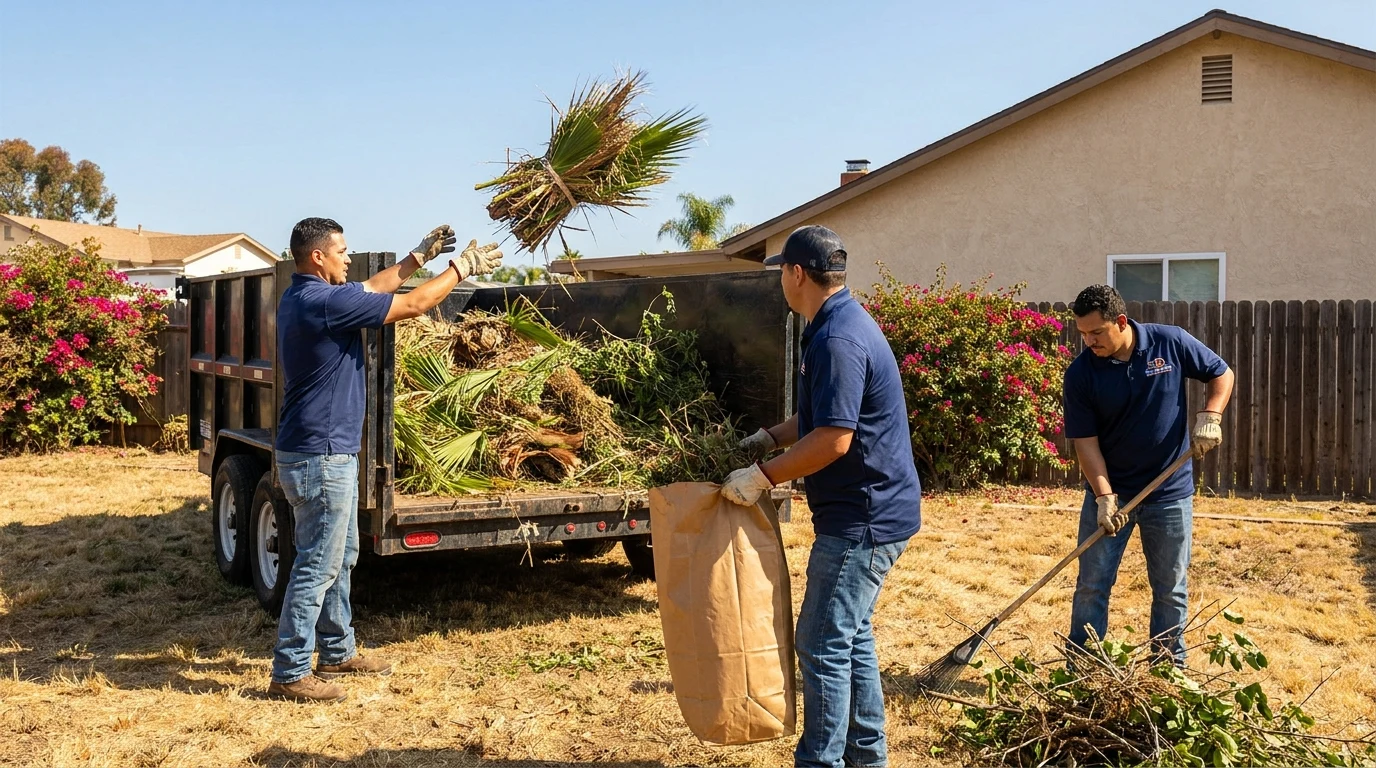
San Diego County treats yard waste as its own category. Most residential customers get a green-topped bin through their trash hauler for grass clippings, leaves, small branches, and prunings. That bin goes to a composting facility, not the landfill, which is good for the environment and keeps disposal costs lower for everyone.
The catch is volume. A standard 96-gallon green bin fills fast once you’ve trimmed a few shrubs or hauled out a palm tree’s worth of fronds. You can put out extra bags on collection day in many jurisdictions, but rules vary by city and by waste hauler. Chula Vista, Oceanside, Escondido, and El Cajon all use different service contracts, so what works in one neighborhood may not work in another.
CalRecycle tracks California’s green waste diversion requirements by jurisdiction. The state requires a large share of yard waste to be composted or mulched rather than landfilled. That’s why haulers are required to collect it separately and why you can’t legally mix it into your regular trash bin in most San Diego cities.
Illegal dumping of yard waste, particularly on roadsides or in canyon areas, carries fines and can trigger brush fire hazards. The City of San Diego Environmental Services has a hotline for reporting illegal dumping and can connect you with bulky green-waste collection options if you need more than your bin allows.
If you’re doing a big landscaping overhaul, the volume almost always outpaces what your bin service can handle in a single week. That’s when most people start looking at other options.
What counts as yard waste vs debris
This distinction matters because it affects where the material goes and how much you’ll pay to get rid of it.
True yard waste is organic: grass cuttings, leaves, hedge trimmings, small branches, palm fronds, pulled weeds, and tree prunings under about four inches in diameter. This material can be composted or chipped into mulch, which is what your green bin service does with it.
Once you cross into larger material, like a trunk section, a root ball, or a load of mixed dirt and rocks, you’re in a different category. Those items usually go to a wood recycler or to a transfer station that handles mixed green and inert waste. The cost per ton goes up, and not every green waste facility accepts all of it.
Concrete, pavers, tile, and dirt are construction-type debris, not yard waste, even if they came from a landscaping project. If your backyard renovation generated both green waste and broken concrete, those piles need to be kept separate, or you’ll pay construction debris rates for everything. Our construction debris removal service handles the hard material while our yard waste removal crew takes the organic side.
Mixed loads get charged at the higher rate at most facilities. If you’ve got both a torn-out lawn and some gravel and broken stepping stones, plan on having those separated before the crew arrives. It’ll save you money and speed up the load time.
Painted wood, treated lumber, and composite decking are also not yard waste. They contain chemicals that composting facilities can’t process. Those materials go to the general-waste landfill or, in some cases, are accepted at specific transfer stations with the right permits.
Branches, stumps, and the heavy stuff
A full-grown eucalyptus can produce a shocking amount of material when it comes down. One tree can easily fill two full-size dump trailers once it’s cut up and loaded. Palm trees are similarly deceptive: the fronds are light individually but stack up in volume fast, and the trunk is dense and heavy.
Stumps are their own problem. If a tree service cut the tree and left the stump, you’ve got a few options. Stump grinding leaves behind a pile of wood chips and ground material, most of which can go into your green bin over several weeks. But the stump grinder grinds only to a few inches below grade, leaving the root system in place. A full root ball extraction, which requires an excavator, produces a mass of soil and organic material that’s too large for any residential bin.
For junk removal crews, stump hauling means loading a heavy, awkward mass of wood, dirt, and roots into a truck or trailer. It’s doable but it requires the right equipment and enough crew to handle the weight safely. A 24-inch stump from a mature tree can weigh several hundred pounds once pulled.
Large branch piles need to be accessible to the truck. If your material is piled in the back corner of a hillside lot, a crew may need to stage it near the driveway before it can be loaded. Factor that into your timeline. Jobs that look like a two-hour haul can stretch to four hours when the access is tricky.
Chipping on-site is an option for some material. If you have a landscaper or arborist doing the cut work, ask whether they offer chipping. Chips can go back into your yard as mulch, which costs nothing to dispose of and improves the soil. What can’t be chipped, roots, large trunks, and dense palm material, still needs to be hauled.
Fire-season brush clearing
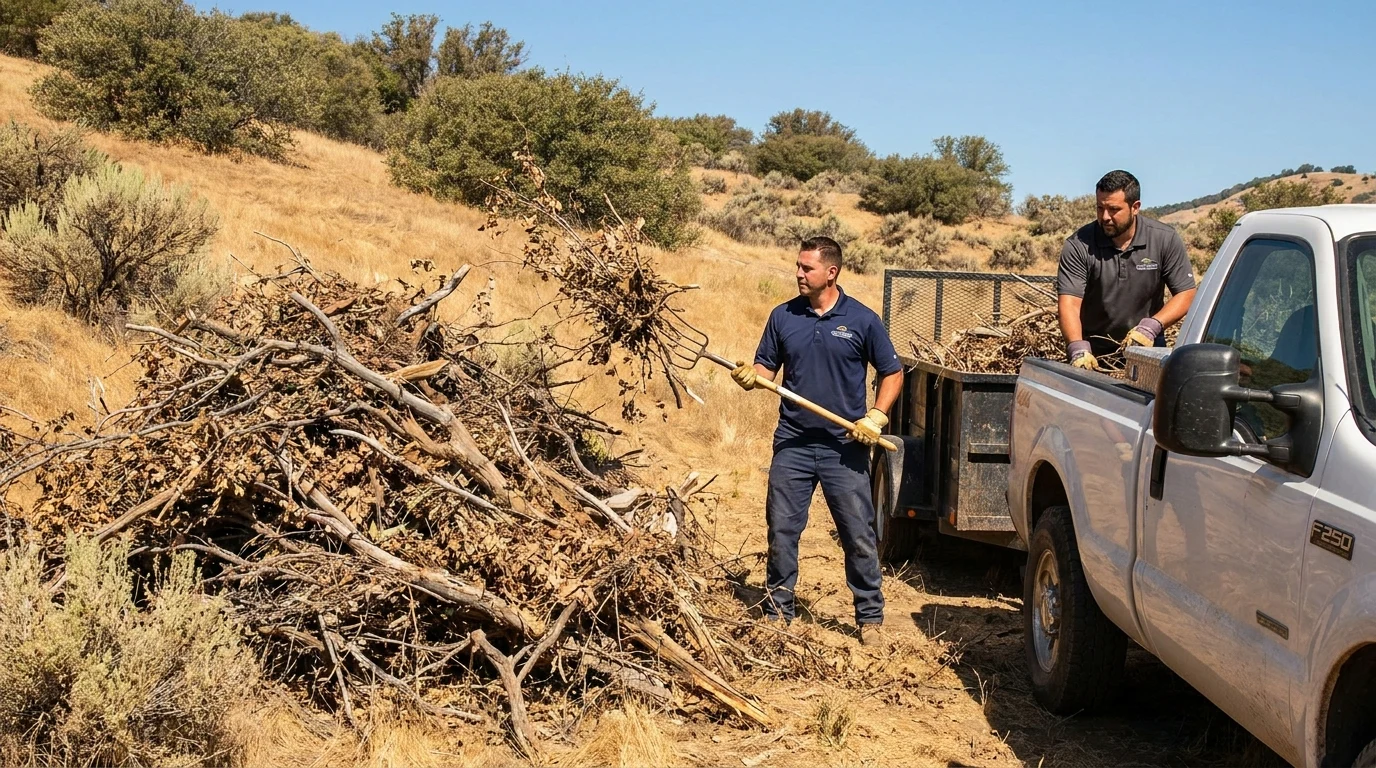
San Diego’s fire history makes brush clearing more than a cosmetic project. If your property sits in a Very High Fire Hazard Severity Zone (VHFHSZ), you have a legal obligation to maintain fuel modification zones. CAL FIRE and local fire jurisdictions can and do issue notices of violation for properties that don’t meet clearance requirements.
The standard is 100 feet of clearance from structures in unincorporated areas, though the specific requirements vary by jurisdiction and slope. The city of San Diego has its own fire code requirements under a Brush Management Program. Notices go out on a schedule, and there are deadlines attached.
The material that comes from brush clearing, dry chaparral, ceanothus, chamise, sage, and similar native shrubs, generates substantial volume quickly. A half-acre slope can produce 10 or more cubic yards of material once it’s cut and piled. That’s too much for any residential bin setup, and many properties in fire zones don’t have reliable green bin service at all.
CalRecycle tracks where green waste facilities are and which ones accept vegetation. Some fire-cleared material can go to biomass energy facilities as well. The key is separating clean green material from anything that has soil or rock mixed in, because mixed loads cost more to process.
Timing matters in a different way for brush work. Late spring, before fire season peaks, is when most homeowners get serious. If you’re planning a major clearance, booking a crew in April or early May is smarter than waiting until late June when everyone else is trying to beat the same deadline. You’ll have more scheduling flexibility and won’t be competing with your neighbors for the same two-week window.
If you get a notice from San Diego Fire, the compliance window is usually 30 days. A professional crew that handles large green waste loads can clear and haul in a single day for most residential parcels, which is worth a lot when you’re facing a deadline.
When to call a crew instead of bagging it
Bagging your own clippings works well for light, routine yard maintenance. It doesn’t work when you’re dealing with a major pruning job, a tree removal, post-storm debris, or a brush clearance project that generates more than your bins can absorb in a week or two.
The math shifts once you account for your time, the cost of bags, and the labor of moving heavy material. A full afternoon of cutting and bagging a tree’s worth of material is exhausting, and you’ve still got the bags sitting at the curb. A crew that hauls everything in a single load is often worth more than the price difference.
We handle everything from palm frond loads to full hillside brush clearance. Our yard waste removal service covers residential and commercial properties throughout San Diego County. If your project also includes dirt, concrete, or inert debris, our team can often sort and handle both on the same visit.
When to call us
If you’ve got more green waste than your bins can handle in a week, a fire-season clearance deadline, or a project that mixed yard debris with heavier material, it’s time to bring in a crew. Call us at (858) 925-5546 for a same-day estimate.