Getting rid of a piano sounds simple until you’re standing next to one. A typical upright weighs 400 to 600 pounds, won’t flex around corners, and needs at least two strong people who know exactly what they’re doing.
Why pianos are so hard to move
A piano is dense, rigid, and awkward in ways that most furniture isn’t. The cast-iron frame inside an upright can weigh 200 pounds on its own. Add the wooden case, strings, keys, and felt dampers and you’re looking at a piece that concentrates most of its mass low and close to the floor.
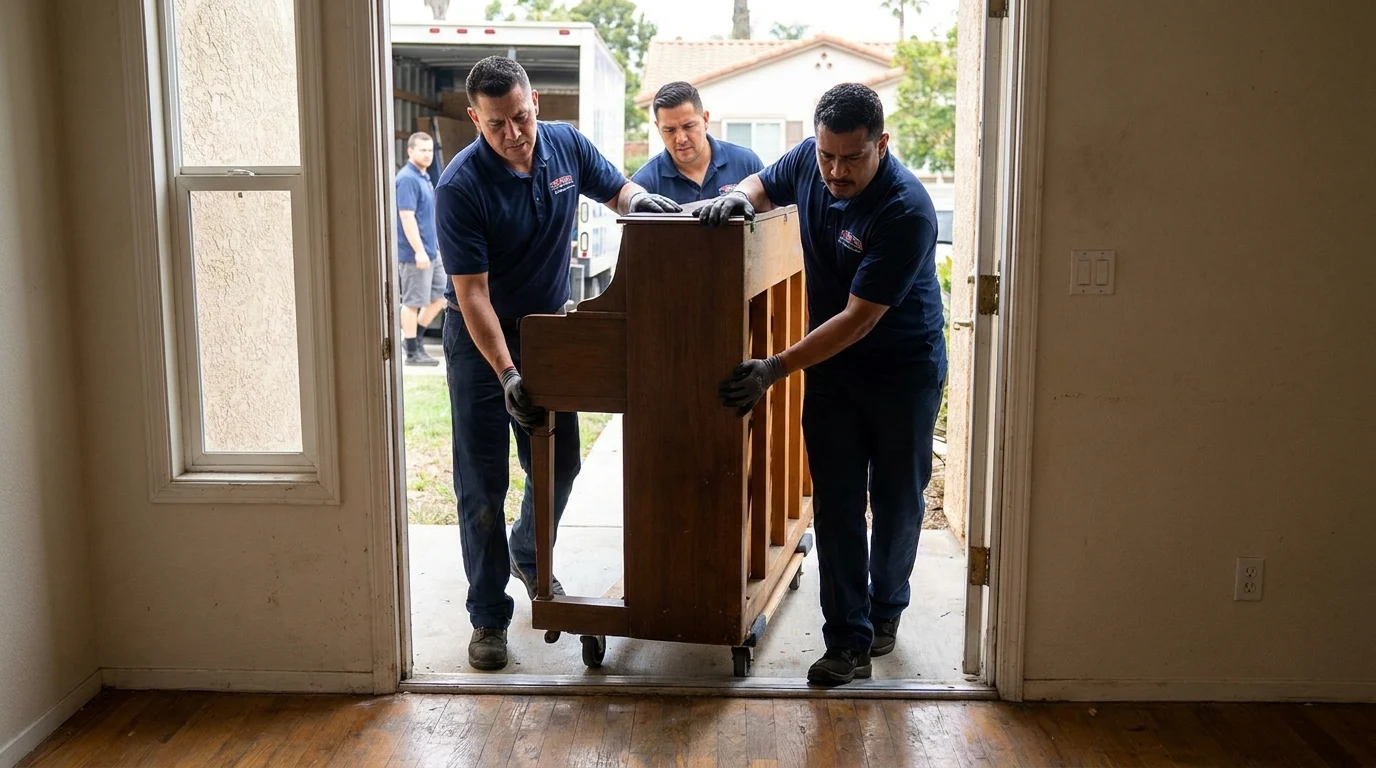
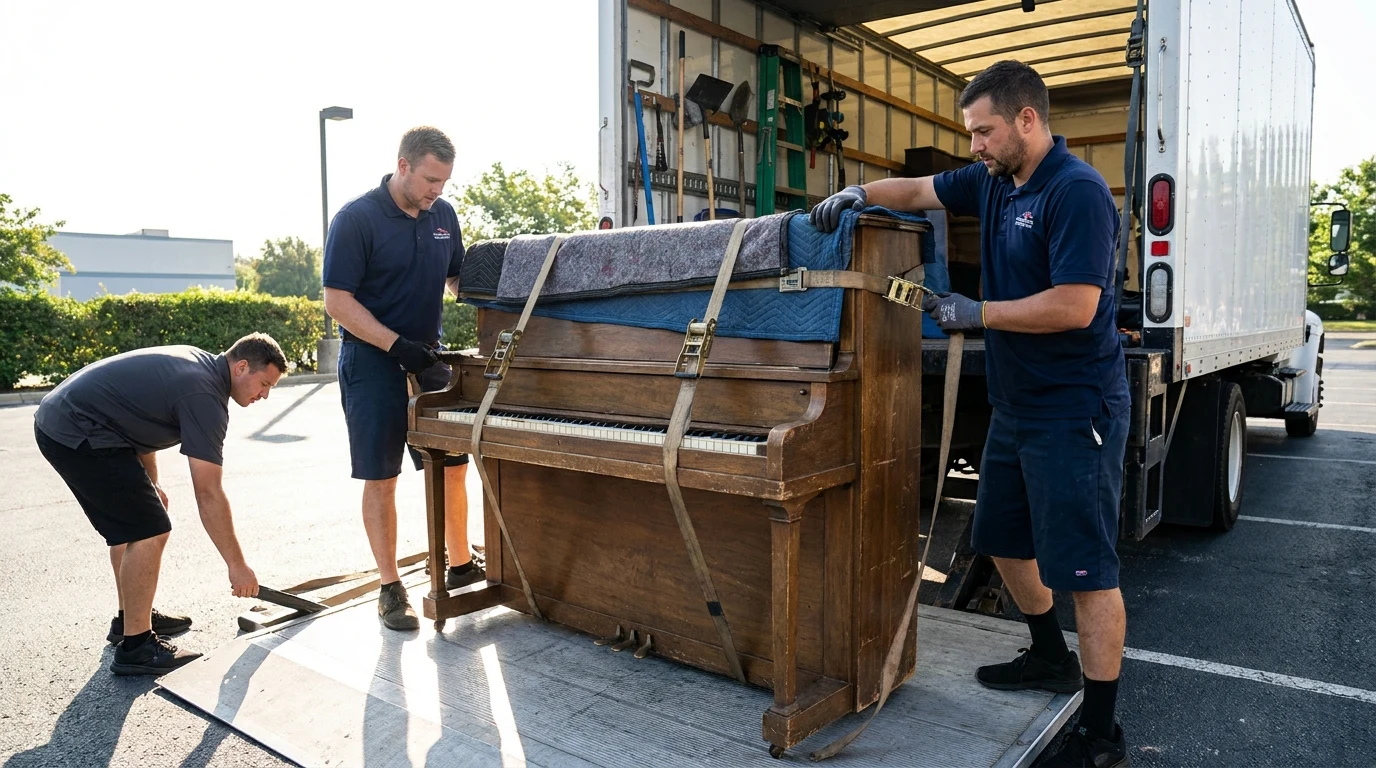
Standard furniture dollies don’t work. You need a piano board, heavy straps rated for the weight, and a crew that knows how to tilt and strap without putting the instrument’s legs through the floor. Rental trucks with lift gates help, but getting from inside the house to that gate is where most damage happens.
Doorways are the main obstacle. Standard interior doorways in San Diego homes run 30 to 32 inches wide. Most upright pianos measure 55 to 60 inches wide. That means the piano goes through at an angle, on its side, tilted back, or sometimes all three at once. Getting that sequence wrong tears up door frames, scuffs floors, and puts crew members’ backs at real risk.
Stairways add another layer. Every step is a controlled tipping point. One misjudged angle and the piano slides, and 500 pounds moving in the wrong direction is not something you can stop by hand. Professional movers use stair rollers, pivot boards, and a dedicated person on each end who knows the count.
This isn’t a job for two friends and a furniture dolly rented from a hardware store. The physics don’t work that way.
Upright vs baby grand vs console
Not all pianos are the same animal, and the type matters when you’re planning a removal.
A console piano is the smallest of the uprights, usually 40 to 44 inches tall and somewhere between 350 and 450 pounds. It fits through most doorways without tilting, though corners and thresholds still need care.
A studio or full upright runs 45 to 52 inches tall and 450 to 600 pounds. These are the most common in San Diego homes. They typically need to be tilted and angled through doorways and can’t always clear standard exterior door frames without removing the door.
A spinet piano is compact and lighter, often under 300 pounds, but its low profile means the keyboard is close to the ground. Getting leverage under it safely requires the right equipment.
Baby grand and grand pianos are a different project entirely. The legs come off first. Then the lid and music desk. Then the body goes onto a special grand board and is moved on its side. A baby grand runs 500 to 600 pounds and a concert grand can hit 1,200. Getting one out of a living room often means measuring the hallway before the crew even starts.
When you call us, tell us what you have. Knowing the type and approximate age helps us bring the right equipment and the right number of people. A three-person crew for an upright is standard. A grand often needs four.
Stairs, doorways, and tight turns
San Diego’s housing stock is varied enough that no two piano removals look the same. A ranch-style home in El Cajon gives you wide hallways and a single step at the entry. A North Park Craftsman might have steep stairs, a narrow hallway, and a 29-inch doorway that was never designed for a piano.
Before the crew starts, they walk the route. That means measuring doorways, checking the staircase pitch, noting handrail positions, and identifying any tight turns between the piano and the truck. A route that looks passable can hide a pivot point that makes everything harder.
Doorways that are too narrow sometimes need the door (and occasionally the door frame) temporarily removed. That’s a standard part of piano removal and doesn’t cause lasting damage if done carefully. Crew members score the paint line first, remove the hinge pins, and reset the door after the piano is out.
Stairs require a board, proper strapping, and a clear communication system between crew members. Nobody moves until everyone is ready. The pace is deliberate, not rushed.
Outside, the path from the door to the truck matters too. Uneven driveways, stepping stones, and soft ground can all cause a dolly to catch. A good crew scouts this and adjusts before loading the piano’s weight onto a wheel.
Our furniture removal crew handles pianos regularly across San Diego County, and no two jobs go exactly the same. The walk-through is where the real work starts.
What piano removal costs and why
Piano removal in San Diego typically runs between $150 and $400 for a standard upright, depending on a few real factors.
Accessibility is the biggest one. A piano on the ground floor of a single-story home with a wide hallway and direct driveway access is the easiest job. A studio upright on the second floor of a La Mesa condo with a narrow staircase is a harder job that takes longer and needs more crew.
Type and size matter too. Console and spinet pianos at the lighter end of the scale cost less than a full upright or a grand. A grand piano removal, with disassembly, is priced separately and usually starts around $300 to $500 depending on size and access.
Distance and disposal factor in as well. Some pianos can be donated if they’re in playable condition. Others go to a recycling facility where the cast iron, steel strings, and wood are separated. Disposal fees for a non-donatable piano get folded into the quote.
The reason piano removal costs more than hauling a sofa is simple: the weight, the risk, and the specialized equipment. A standard junk removal crew can haul a sofa in 20 minutes. A piano job takes 45 minutes to an hour at minimum, often longer, with three people and specific gear.
Get an on-site estimate so the price reflects your actual situation. What looks like a standard upright removal on paper sometimes turns into a staircase job that needs extra hands.
For more on how San Diego hauling and furniture removal is priced overall, see our post on furniture removal in San Diego.
Donating a piano that still plays
A piano in working condition doesn’t have to go to a landfill. Schools, churches, community centers, and music programs across San Diego County sometimes accept donated uprights, especially if the piano is in tune or close to it.
The key word is working. Donation recipients need an instrument that can actually be played. Missing keys, broken hammers, warped soundboards, or a piano that’s been out of tune for years without servicing are harder to place. Some organizations will take a piano that needs minor work. Few will take one that needs a full restoration.
Before you call for pickup, honest self-assessment helps. If the last time anyone played it was fifteen years ago and half the keys stick, donation may not be realistic. If it was serviced a few years back and the tone is still decent, it’s worth making calls.
Places to try in San Diego: public elementary schools with music programs, community recreation centers, local churches, and nonprofits that run music education. Some will arrange their own transport if the piano is free and accessible. Others need you to deliver it, which brings you back to the moving problem.
If donation doesn’t pan out, recycling is the responsible path. Piano recycling recovers the cast iron plate, copper and steel wire strings, and hardwood components. Very little of a piano actually needs to end up in a landfill. The City of San Diego’s Environmental Services department at sandiego.gov/environmental-services has resources on large-item disposal and recycling if you want to verify local options.
Our crew can help you think through this when you call. If the piano is in good shape and might be donatable, we’ll say so. If it needs to be hauled, we’ll tell you that too.
When to call us
A piano that needs to go is not a weekend DIY project, and waiting doesn’t make it easier. Call us at (858) 925-5546 for a same-day estimate.