Old televisions pile up fast. Maybe you upgraded to a bigger screen, cleared out a bedroom, or you’re finally dealing with the 90s-era tube TV that’s been sitting in the garage for a decade. Whatever the reason, you can’t just drag it to the curb with your regular trash.
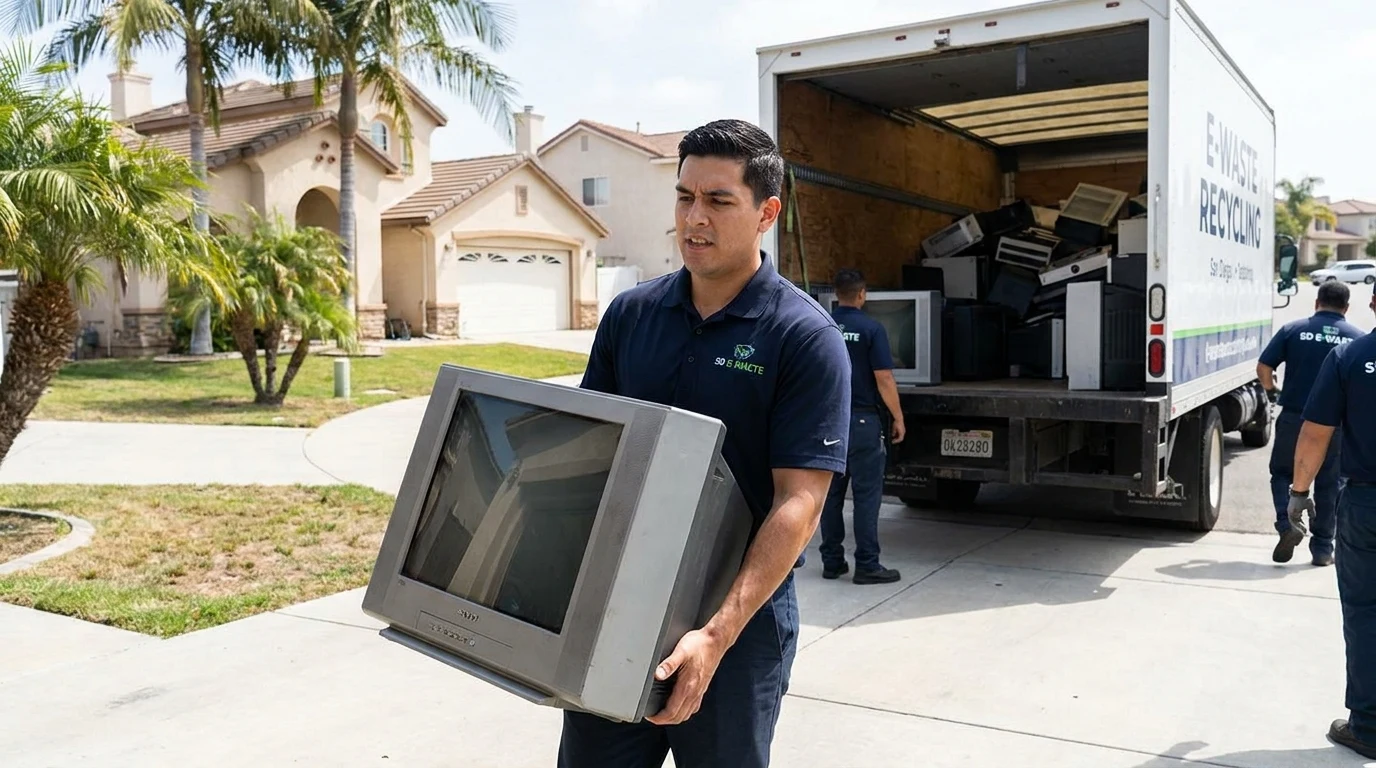
Why TVs are banned from the regular trash
California law bans televisions from landfills and regular trash bins. This isn’t a suggestion, it’s state law under the California Electronic Waste Recycling Act. The reason is straightforward: televisions contain toxic materials, including lead, mercury, cadmium, and other heavy metals, that leach into soil and groundwater when buried in a landfill.
Flat-screens use less of these materials than older CRT sets, but both fall under the same disposal restrictions. The City of San Diego and San Diego County enforce this through their waste contracts. Trash haulers won’t pick up electronics, and transfer station workers will reject TVs tossed in with general debris.
This isn’t a technicality that rarely gets enforced. Garbage truck drivers are trained to spot electronics, and illegal dumping of TVs along roadsides in San Diego County carries real fines. Beyond the legal side, it’s genuinely harmful: a single CRT television can contain 4 to 8 pounds of lead, which is enough to contaminate a significant amount of groundwater if it ends up in the wrong place.
CalRecycle’s website has the full breakdown of California’s e-waste rules if you want to understand exactly what’s covered. The short version: all televisions, regardless of type or age, need to go through a certified recycler.
Flat-screens vs old CRT tube TVs
Not all old TVs create the same disposal challenge, but both types need proper recycling. The key difference is weight and the recycling process.
Flat-screen TVs (LCD, LED, OLED, and plasma) are relatively light. A 55-inch flat-screen typically weighs 30 to 60 pounds. They contain some hazardous materials, but the construction makes them easier to transport and recycle. Most e-waste drop-off programs accept flat-screens without issue.
CRT televisions (the boxy tube sets made before about 2010) are a different situation entirely. A 32-inch CRT can weigh 100 to 150 pounds. The glass alone in older CRTs contains a significant percentage of lead by weight, which is why specialty recyclers handle them separately. Some facilities that accept flat-screens for free charge a fee for CRTs, typically $15 to $30 per unit, because the processing cost is higher.
There’s a practical issue too: CRTs are awkward to carry. The glass is fragile, the weight is concentrated in the back, and the boxy shape makes it hard to grip. Dropping one isn’t just a mess, it’s a hazardous materials situation. If you’ve got a CRT in a second-floor bedroom or at the back of a storage unit, getting it out safely takes two people and some planning.
Plasma TVs are less common but worth mentioning. Plasma screens contain small amounts of mercury and xenon gas. They’re handled the same way as other flat-screens at most certified e-waste facilities.
Free e-waste drop-off spots
San Diego County has a solid network of free e-waste drop-off options. The key is knowing which ones accept televisions, because not every facility takes every type of electronics.
StopWaste San Diego drop-off events. The City of San Diego and the County run periodic free e-waste collection events throughout the year. These are typically held on weekends at community centers or public parking lots. Check the City of San Diego Environmental Services website for the current schedule. These events accept TVs at no charge, including CRTs.
Miramar Greenery and Recycling Center. The Miramar facility at 5180 Convoy Street accepts household hazardous waste and e-waste from San Diego city residents on specific days. City residents can drop off televisions here for free. You’ll need to show proof of San Diego city residency.
Certified e-waste recyclers. Several private, state-certified e-waste recyclers in San Diego County accept TVs. eRecyclingCorps, GreenCitizen, and similar operations maintain drop-off locations or scheduled pickup days. Search the CalRecycle certified collector database to find locations nearest you. Fees vary: many accept flat-screens for free, while CRTs may carry a small charge.
Retailer take-back programs. Some electronics retailers, including Best Buy, accept old televisions for recycling. Best Buy currently charges a fee for CRT and projection TVs but accepts most flat-screens for free. Call ahead to confirm what your local store accepts before hauling the TV in.
If your TV still works, donating it is worth considering before going the recycling route. Goodwill and the Salvation Army accept working televisions at most San Diego locations. Habitat for Humanity ReStores sometimes take working flat-screens too. Read our donation pickup San Diego guide to understand what charities will and won’t take, and whether a free pickup is possible.
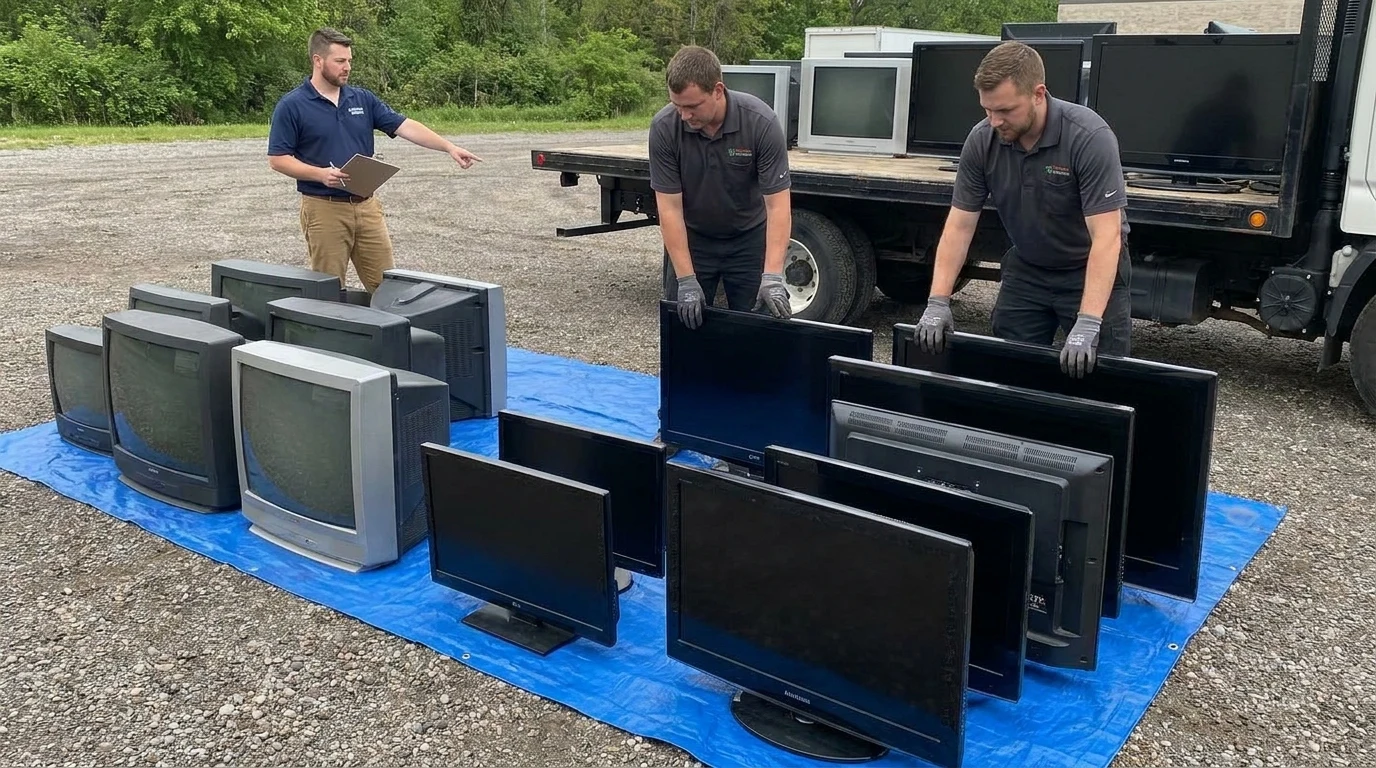
What recyclers do with the parts
Understanding what happens after drop-off helps explain why certified recycling matters and why some facilities charge for certain TV types.
When a flat-screen TV arrives at a certified e-waste facility, workers first strip it of components that have resale or reuse value: power supplies, certain circuit boards, copper wiring, and aluminum framing. The LCD panel is separated and processed for its indium content, a rare metal used in touchscreens and displays. The plastic housing is shredded and sorted for plastics recycling.
CRT televisions go through a more involved process. The glass in a CRT screen is leaded glass, meaning it contains actual lead as part of the glass composition. Recyclers use specialized equipment to separate the leaded glass from the clear glass funnel, then process each type separately. The leaded glass is either used in new industrial applications or processed to extract the lead. This specialized handling is what drives the higher processing cost.
Both types recover meaningful materials: copper, aluminum, steel, and various circuit board metals including small amounts of gold, silver, and palladium. Responsible recycling keeps these materials in the supply chain and out of landfills.
California funds part of this system through the Electronic Waste Recycling Fee. When you bought a new TV, you paid a fee at checkout (typically $8 to $25 depending on screen size) that funds free consumer e-waste recycling programs. So the free drop-off events are effectively pre-paid. That’s also why flat-screens can often be dropped for free while older CRTs, which cost more to process, may carry a small charge.
Choosing a certified recycler matters. Some operations ship e-waste overseas to facilities that process it with minimal worker protection or environmental controls. Certified California e-waste processors are audited and required to meet stricter standards. The CalRecycle database lists only certified collectors, so it’s a reliable starting point.
Getting a heavy TV out without breaking it
The logistics of moving an old TV, especially a large CRT, are where things go wrong. Here’s how to handle it without injuring yourself or cracking the screen.
For flat-screens, the main risk is cracking the panel. Never lay a flat-screen face-down without proper support, and don’t grab it by the stand. Use both hands on the sides, and if it’s over 50 inches, have a second person help. Most flat-screens have a thin bezel with no good grip points, so go slowly around doorframes.
For CRTs, weight is the primary challenge. A big tube TV needs two people. The awkward weight distribution means the back of the set is heavier than the front, so the person on the heavier end carries the bigger load. Use appliance straps if you have them. Clear the path from the TV’s current location to where you’re loading it before you pick it up, because you can’t easily adjust your grip once the set is in the air.
Stairs add real risk. A 100-pound CRT on stairs with two people requires communication and a clear plan before you start. Both people need to know who’s going forward and who’s backing up. Going down stairs with a CRT is slower and more controlled than going up.
For large TVs in hard-to-reach spots (second-floor rooms, tight closets, back corners of storage units), professional appliance removal saves you the strain and the risk of a dropped set. Our crew handles this kind of job regularly, and we’re familiar with the specific challenge CRTs present.
Once the TV is accessible, transport in a vehicle that can handle the weight and size. Most flat-screens fit in a midsize SUV laid flat on a blanket. CRTs need a pickup truck bed or cargo van. Secure the set so it can’t slide during transit.
If you have multiple electronics to get rid of at once, consider whether a single trip to a drop-off site makes sense. Check our electronics recycling San Diego guide for a full rundown of what drop-off programs accept and where they’re located.
For a full house cleanout involving multiple TVs, old appliances, and other bulky items, full-service junk removal handles everything in a single appointment rather than making separate trips to multiple facilities.
When to call us
If you’ve got a heavy CRT, a TV in a hard-to-reach spot, or a home full of old electronics you need cleared in a day, it’s worth calling a crew. We handle the heavy lifting, transport, and certified recycling so you don’t have to coordinate drop-off locations or risk a back injury on a 150-pound tube set. Call us at (858) 925-5546 for a same-day estimate.