Most people have never hired a junk removal crew before. They don’t know what to expect, whether they need to sort anything in advance, or how the price gets set. The whole thing feels vague until you’ve done it once. Here’s exactly how it works.
The simple four-step process
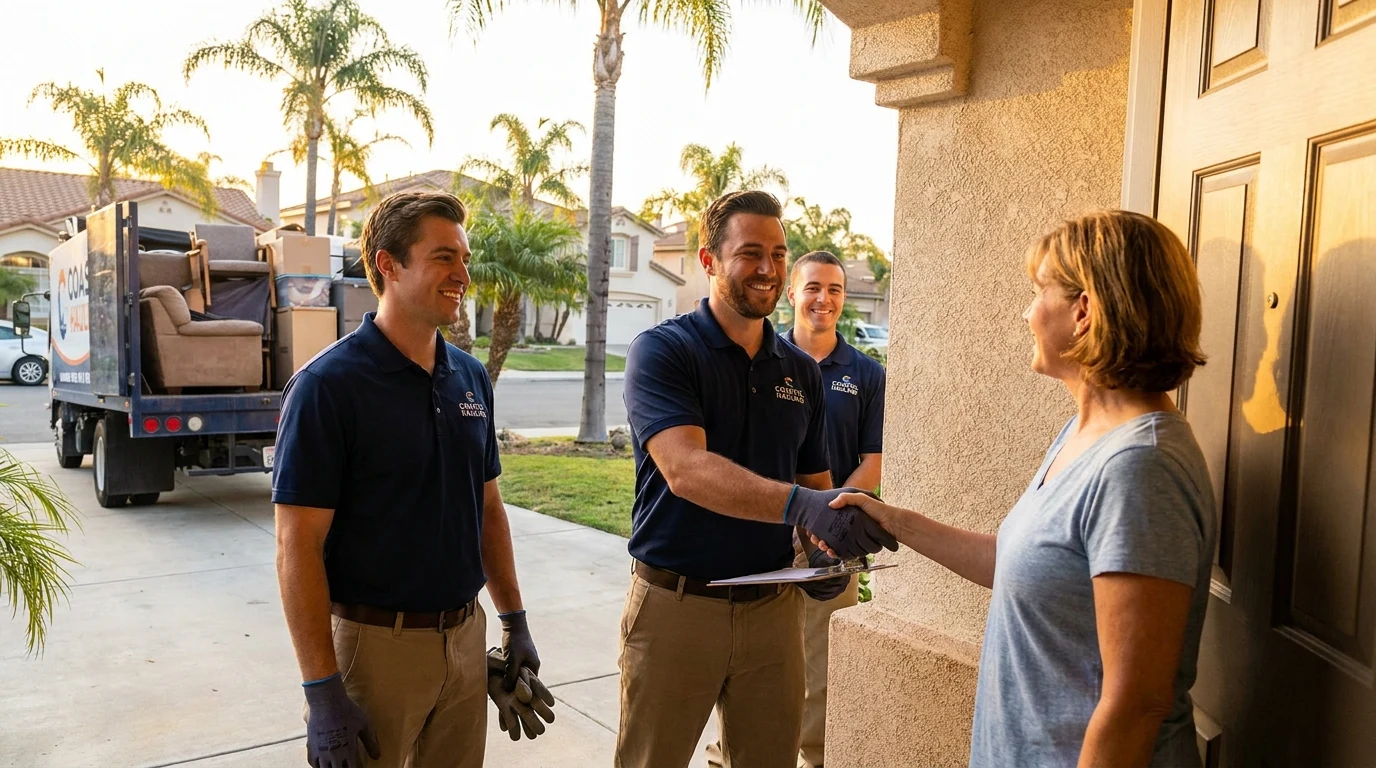
Booking junk removal is easier than most people expect. You call or schedule online, a crew shows up at the time you chose, they look at what you have, they give you a price, and if you agree, they load everything and take it away. You don’t touch a thing after that.
Step one is the call or booking. You describe what you have, whether it’s a single couch or a garage full of stuff, and you pick a window that works. Two-hour arrival windows are standard. Most San Diego crews can get to you the same day or next morning.
Step two is the on-site visit. The crew walks the area with you. They look at the volume, note anything heavy or awkward (a treadmill on the second floor, a hot tub in the backyard), and factor in where the truck can park. This is when the real quote happens, not over the phone.
Step three is the actual loading. Once you approve the price, the crew handles everything. They carry items out, load the truck, and sweep up if needed. You don’t need to disassemble furniture, move things to the curb, or sort anything ahead of time, though sorting can help with donations.
Step four is the debrief. The crew lets you know what went to donation, what went to recycling, and what went to the transfer station or landfill. You get a receipt and you’re done.
The whole thing, from crew arrival to truck leaving, typically runs 30 minutes to two hours depending on volume. Full-service junk removal covers everything from single-item pickups to whole-house cleanouts.
How on-site estimates work
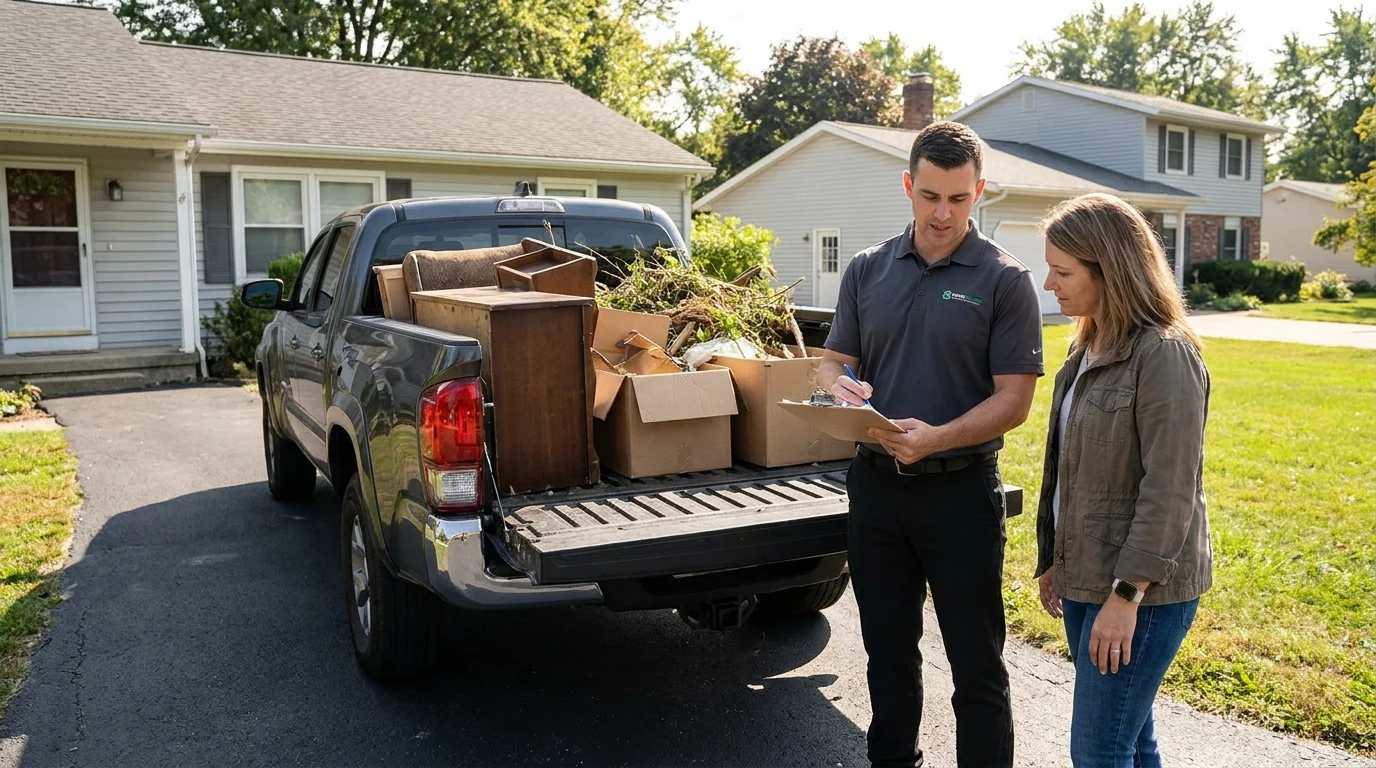
The estimate happens in person, and that’s by design. Junk removal companies don’t price over the phone the way a plumber might quote a faucet swap. The reason is simple: every load is different, and the crew needs to see what they’re dealing with.
When the crew arrives, they walk through the space with you. They’re looking at a few things: how much volume there is, how heavy the items are, and how complicated the access is. A bookshelf on a ground-floor patio is a five-minute lift. A cast-iron safe up a flight of stairs with a 90-degree turn is a different job entirely.
Volume is the main driver. Most crews use truck space as the unit of measure, ranging from a small fraction of a truck to a full load. The more space your junk takes up in the truck, the more it costs. That’s it.
You’re not obligated to accept the estimate. If the number doesn’t work for you, you say no and the crew leaves. No charge, no pressure. That’s the standard in San Diego.
One thing worth knowing: the estimate you get on-site is usually firm. The price doesn’t go up once loading starts, as long as the job is what the crew saw. If you add a pile from the garage that wasn’t part of the original walkthrough, that gets priced separately.
If you want a sense of the typical ranges before your crew arrives, the junk removal cost guide for San Diego in 2026 breaks down pricing by volume and item type.
Volume-based pricing explained
Junk removal pricing is almost always based on how much space your items take up in the truck, not on the number of pieces or the time it takes to load them. This model is called volume-based pricing, and it’s the industry standard.
Think of a standard junk removal truck as having roughly 16 cubic yards of usable space. Crews divide that into fractions: a quarter load, a half load, three-quarters, and a full load. Where your junk falls in that range determines your price.
A small pickup, like a single mattress and a few boxes, might be a quarter load or less. A two-car garage cleanout might run three-quarters to a full load. An estate cleanout or whole-house job often fills multiple trucks.
A few factors push the price up beyond pure volume. Heavy items cost more per cubic yard than light ones, because weight affects disposal fees and truck capacity. Difficult access, a tight stairwell, a narrow gate, or a backyard that requires hand-carrying, adds time and effort. Some items carry a flat surcharge regardless of size: mattresses, appliances with refrigerant, and tires are the most common.
San Diego County disposal fees also factor in. The Miramar Landfill and regional transfer stations charge by the ton. When your load is heavy, some of that cost gets passed along.
What happens to your stuff after pickup
Most people assume everything goes straight to the landfill. In practice, a responsible San Diego junk removal crew sorts every load before disposal. Usable furniture and household goods go to donation partners first. Metal gets separated for recycling. Electronics and appliances go to certified e-waste and recycling processors. What’s left, the stuff that genuinely has no second life, goes to the transfer station or landfill.
The donation leg is more active than most clients expect. Items in decent shape, couches, dressers, lamps, working small appliances, get dropped at Habitat for Humanity ReStores, Goodwill, or other local nonprofits. This extends the life of things that would otherwise fill landfill space and helps local organizations at the same time.
Appliances require special handling under California and federal rules. Refrigerators, air conditioners, and dehumidifiers contain refrigerants that must be recovered by a certified technician before the appliance can be crushed or recycled. You can read about those regulations on the EPA’s Section 608 page. Clear Out San Diego works only with processors who meet that standard.
Mattresses in California go through the Bye Bye Mattress program, which is run by the Mattress Recycling Council. The foam, steel, and fabric are broken down and turned into carpet padding, new steel, and other products. Mattress removal is one of the more regulated pickups in San Diego, and a good crew handles the certification paperwork automatically.
For general recycling and waste diversion guidance in California, CalRecycle has a searchable database of certified facilities by material type and zip code.
How to get the fastest service
Same-day service is available most days across San Diego County, but it helps to call early. Crews fill their routes in the morning. A call before 10 a.m. gives you the best shot at a same-afternoon window. Booking the night before is even better.
A few things make the job go faster once the crew arrives. You don’t need to move anything yourself, but if you can point the crew directly to what needs to go versus what stays, that speeds up the walkthrough. If you have items on multiple floors or in multiple buildings, a quick tour at the start helps them plan the load sequence.
If you have items that might be donated, set them aside if possible. Crews appreciate knowing upfront what’s earmarked for charity so they can stage those separately and protect them from the haul-away pile.
For jobs that are time-sensitive, things like a lease-end deadline, an estate closing, or a move-out the following morning, mention that when you call. Same-day hauling is a specific service we offer for exactly those situations, and knowing the deadline lets the dispatcher prioritize accordingly.
If you’ve already done some sorting and just need a quick pickup of what’s left, that’s typically a faster job than a full cleanout. The crew can often work you into a shorter window, which means a lower cost and less time coordinating.
When to call us
If you’ve got more than you can fit in your car, items too heavy to carry solo, or a deadline that doesn’t leave time to figure out drop-off logistics yourself, a professional crew is the right move. Call us at (858) 925-5546 for a same-day estimate.