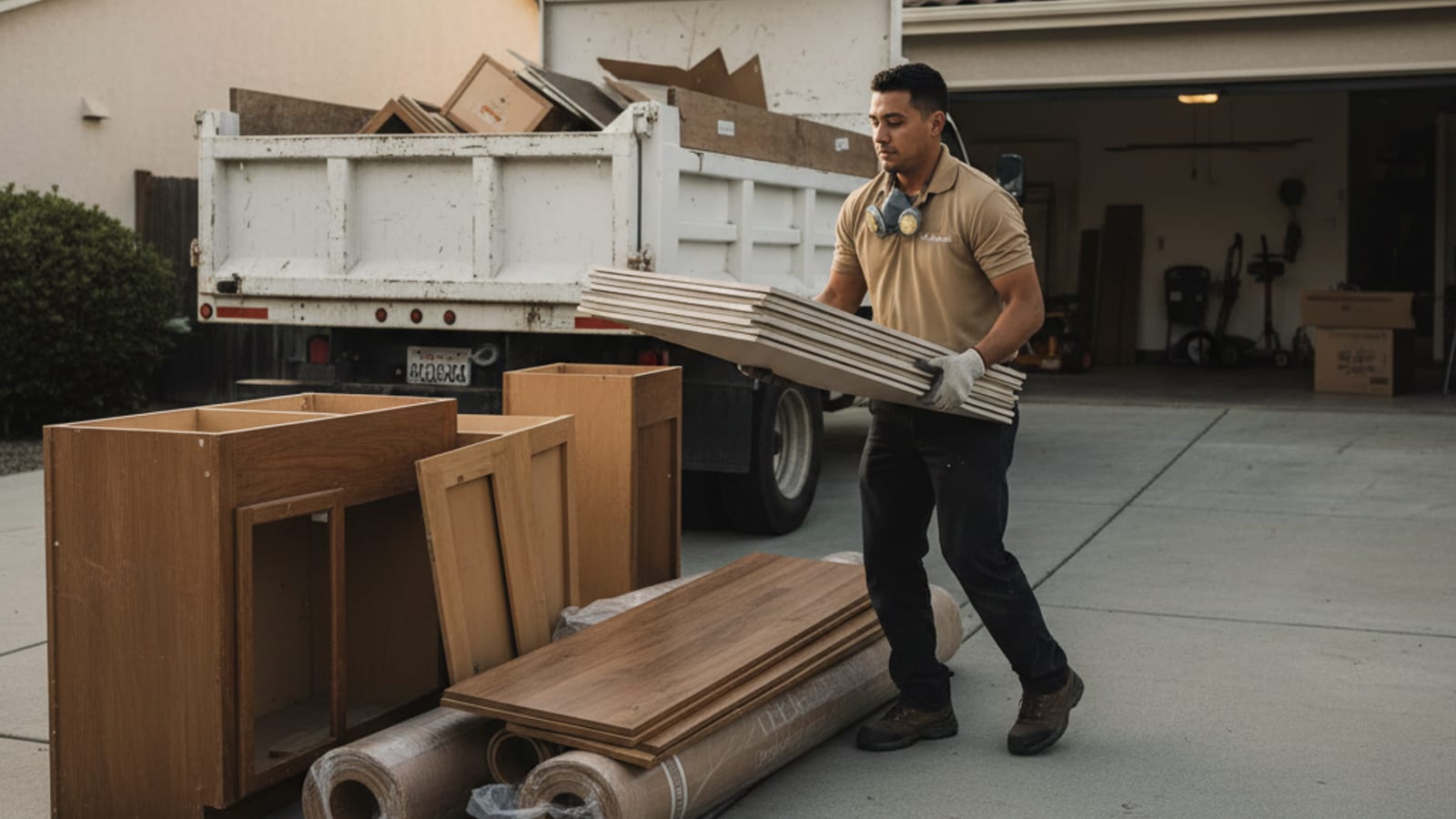
Construction debris removal in San Diego runs from about $250 for a quarter-truck of remodel scrap to $750+ for a full load of dense material like tile and concrete. Pricing is volume-based, but debris is heavy, so weight and disposal fees matter more here than with household junk. Below is what you’ll actually pay, where it goes, and the local rules that catch contractors off guard.
What counts as construction debris
If it came out of a build, a remodel, or a demo, it’s construction debris. The common loads we haul in San Diego:
- Drywall, plaster, and lath
- Lumber, framing scrap, and old decking
- Tile, grout, and busted ceramic
- Concrete, brick, block, and mortar
- Roofing shingles and underlayment
- Flooring: carpet, vinyl, laminate, hardwood, tile
- Cabinets, countertops, and old fixtures
- Drywall mud buckets, scrap insulation, and packaging
What we don’t take without a heads-up: asbestos, lead paint debris, wet paint, solvents, and other hazardous material. Those need a licensed hazmat hauler, not a junk truck. More on that below.
How San Diego construction debris pricing works
Junk removal is priced by volume, the fraction of a 20-cubic-yard truck your debris fills. But construction debris is dense. A half-truck of drywall and tile can weigh as much as a full truck of couches and boxes. Honest haulers price the heavy stuff a little higher because the landfill charges by the ton, not the truck.
| Load size | Rough volume | Typical debris price |
|---|---|---|
| Single-room remodel scrap | 1/4 truck | $250–$325 |
| Bathroom gut (tile, fixtures, drywall) | 1/3 truck | $325–$425 |
| Kitchen demo (cabinets, counters, flooring) | 1/2 truck | $425–$550 |
| Garage or deck teardown | 3/4 truck | $550–$675 |
| Full remodel haul-off | Full truck (20 cu yd) | $650–$850 |
| Heavy concrete or tile only | Priced by weight | Quote required |
These ranges assume ground-level access and mixed debris. Pure concrete, brick, or dirt gets quoted separately because it’s so dense the landfill weight fee drives the cost. Always ask for an upfront quote before the truck loads. For a full breakdown of how volume pricing works across every job type, see our San Diego junk removal cost guide.
Where construction debris goes in San Diego County
This is where local knowledge actually saves you money. San Diego has specific facilities, specific fees, and specific rules.
Miramar Landfill (the main destination)
The Miramar Landfill on Convoy Court is where most San Diego construction debris ends up. It’s run by the City of San Diego. As of 2026, mixed construction and demolition debris runs roughly $61 to $66 per ton, with a minimum charge for small loads. Clean, source-separated material like concrete, asphalt, and dirt gets a lower rate because it can be recycled at the adjacent recycling area instead of buried.
Two things contractors miss. First, Miramar has a minimum gate fee, so a couple of trash bags of scrap can cost the same as a quarter-ton. Second, the recycling discount only applies if the load is genuinely separated. One pallet of mixed junk in your clean concrete load and you pay the full mixed rate on the whole thing.
Other county options
The county runs additional facilities, and unincorporated areas have their own transfer stations. Sycamore Landfill in Santee takes construction debris on the east side of the county. Rates and accepted materials shift, so call ahead before you drive a loaded truck across town.
The C&D recycling rule
San Diego enforces a Construction and Demolition Debris Diversion ordinance. Permitted projects over a certain valuation have to divert a percentage of debris away from the landfill into recycling, and document it. If you pulled a building permit, your project may owe a diversion report. A hauler that separates and recycles helps you hit that number. One that dumps everything mixed does not.
The rules that catch contractors off guard
A few categories aren’t really construction debris but show up on demo and remodel jobs constantly. They each have their own San Diego rules.
Appliances with refrigerant
Old fridges, AC units, freezers, and water coolers contain CFC or HFC refrigerant. Federal law and California rules require certified refrigerant recovery before disposal. You can’t legally toss a fridge in a debris pile. We route these through proper recovery, and so does any haulers worth hiring. If a price seems too low to cover refrigerant handling, the fridge is probably getting dumped illegally. We cover the details on our appliance removal page.
Mattresses on cleanout jobs
Demo and turnover jobs often include old mattresses. California’s mattress recycling program, run under CalRecycle by the Mattress Recycling Council, means mattresses and box springs get diverted to recycling, not buried. There’s a per-unit recycling fee, so mattresses are priced separately from your debris load.
Paint, stain, and solvents
Leftover paint, thinner, stain, and adhesives are household hazardous waste. They don’t go in a debris truck. San Diego runs a PaintCare program with drop-off sites for leftover paint, and the county operates household hazardous waste collection facilities for the rest. Set these aside before the haul.
Treated lumber and pressure-treated wood
Pressure-treated decking and railroad ties contain preservatives. Many recyclers won’t take them as clean wood, so they go to the landfill at the mixed rate. Sort them out of your clean lumber pile or you’ll lose the recycling discount.
DIY versus hiring a hauler
Honest answer: for small, light loads, a DIY run to Miramar can be cheaper. For anything dense, multi-trip, or on a deadline, a hauler usually wins once you count your time, gas, and your truck’s suspension.
Do it yourself when: the load is small and light, you own or can borrow a truck, you have time for the dump’s hours and the gate line, and the material is clean enough for the recycling rate.
Hire a hauler when: the debris is heavy (tile, concrete, plaster), it’s multiple truckloads, you’re on a job timeline, access is tight, or you need the diversion documentation for a permit. We handle the loading, the sorting, the multiple facilities, and the same-day pickup. See our construction debris service for the full scope.
Neighborhood notes
A few San Diego realities shape construction debris jobs by area.
Coastal neighborhoods like La Jolla, Pacific Beach, and Encinitas have narrow streets, permit parking, and tight lot access. Debris bins often can’t be placed legally without a permit, which is why on-call truck haul-off beats a rented dumpster for smaller remodels here.
Older inland homes in North Park, Normal Heights, and Kensington frequently turn up surprise material during demo: knob-and-tube wiring, old plaster and lath, and occasionally suspect flooring or insulation that needs testing before it moves.
HOA communities in places like Carmel Valley, Scripps Ranch, and 4S Ranch usually have bulky-item and construction debris rules. Many HOAs ban debris bins in driveways or limit how long they can sit, and some require advance notice for any visible haul-off. Same-day truck removal sidesteps the multi-day bin problem entirely. Check your HOA’s CC&Rs before a tile or roofing job, since fines for an unapproved dumpster can erase your savings.
Frequently asked questions
How much does construction debris removal cost in San Diego? Expect $250 to $325 for a quarter-truck of mixed remodel scrap and $650 to $850 for a full load. Dense material like concrete and tile is priced by weight because Miramar charges by the ton, so always get an upfront quote first.
Can I take construction debris to Miramar Landfill myself? Yes. Miramar accepts construction and demolition debris from the public. Expect a per-ton rate around $61 to $66 for mixed loads in 2026, plus a minimum gate fee, and a lower rate for clean separated concrete, asphalt, or dirt.
Do you take concrete, brick, and dirt? Yes, but these get quoted separately because they’re so heavy. Keeping them clean and separated qualifies them for the recycling rate, which lowers your cost.
What can’t a junk hauler take? Asbestos, lead paint debris, wet paint, solvents, and other hazardous material need a licensed hazmat hauler. Appliances with refrigerant and mattresses are taken but handled under their own California recycling rules.
Is a dumpster rental cheaper than haul-off? Not always. In coastal and HOA neighborhoods, dumpster permits, placement limits, and time restrictions add cost and hassle. For one or two truckloads, on-call haul-off is usually faster and simpler.
Do you handle the C&D diversion paperwork for permitted jobs? We separate and recycle so your project can hit San Diego’s diversion requirement, and we can document where the material went. Tell us upfront if your permit requires a diversion report.
Get an upfront quote
We cover all of San Diego County with same-day availability and transparent, volume-based pricing. No surprise fees at the curb. Call (858) 925-5546 for an upfront quote on your construction debris job, whether it’s a single bathroom gut or a full remodel haul-off.