A vacated office suite doesn’t clean itself. Whether you’re closing a location, right-sizing after remote work changes, or handing back the keys at lease end, commercial cleanouts move fast and require a crew that works around your schedule.
What an office cleanout actually involves
Most people picture desks and chairs, and that’s a big part of it. But a full commercial cleanout typically includes much more than the obvious furniture.
You’re often looking at modular workstations that take time to disassemble, filing cabinets loaded with paper that needs shredding or recycling, breakroom appliances, server racks and wiring, standing desks, whiteboards, and stacks of outdated marketing materials nobody wants to carry home.
The volume surprises people. A 10-person office can easily fill a 20-foot truck. A 50-person floor with a full complement of cubicles? Plan on multiple loads.
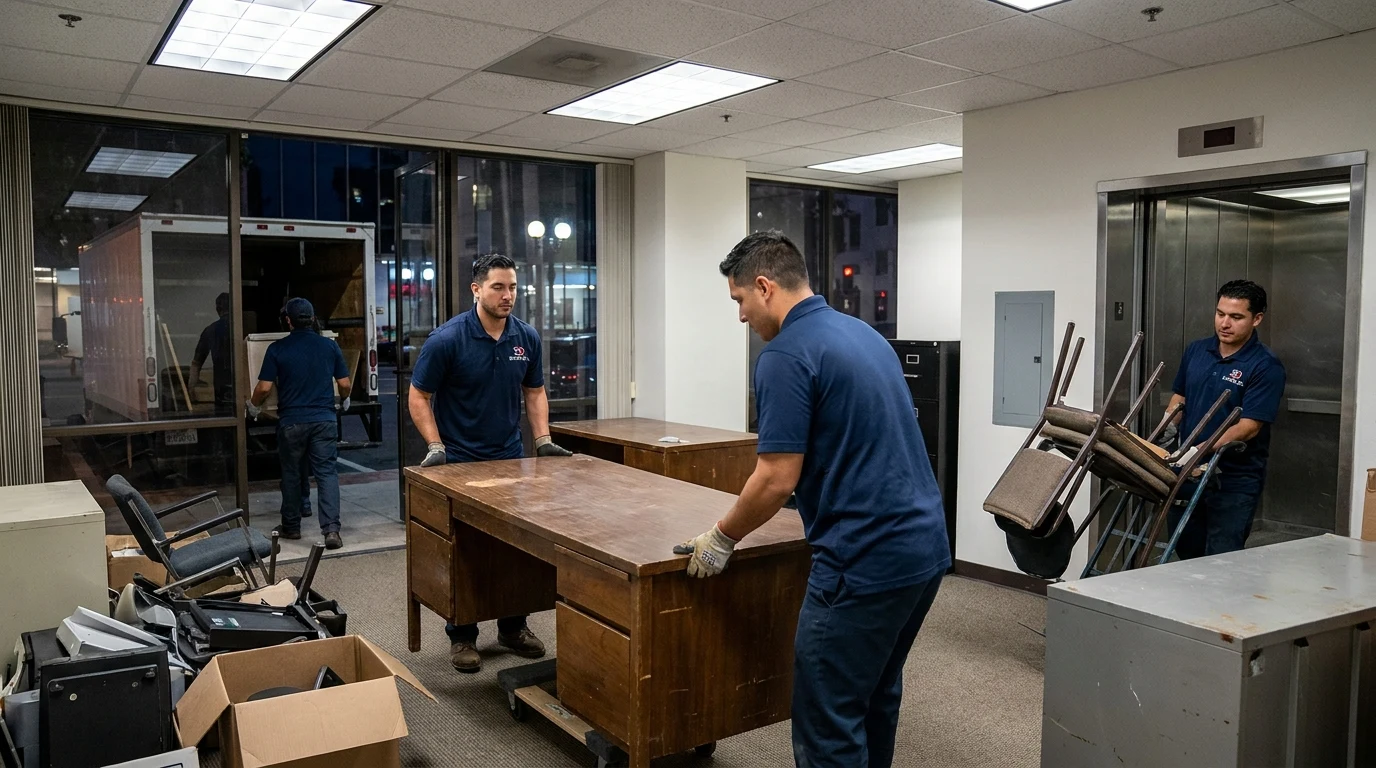
What separates a professional crew from a friend-with-a-truck situation is planning. A good team walks the space first, estimates load count, and builds a clear sequence. Desks and furniture come out first. Electronics go into separate staging areas. The breakroom gets emptied before the lobby. You don’t want a crew improvising in a tight corridor with a 300-pound lateral file.
Our commercial junk removal service covers exactly this kind of work. We’ve cleared everything from single-room offices in Kearny Mesa to entire floors in downtown San Diego. The process is the same: assess, stage, load, haul, and leave the space broom-clean.
If you have items that still have useful life, we sort for donation where possible. Working monitors, chairs in decent shape, and functional breakroom appliances can often go to a local nonprofit rather than the landfill. City of San Diego Environmental Services also has commercial recycling resources worth checking if you have a large volume of electronics or paper.
Cubicles, desks, and old electronics
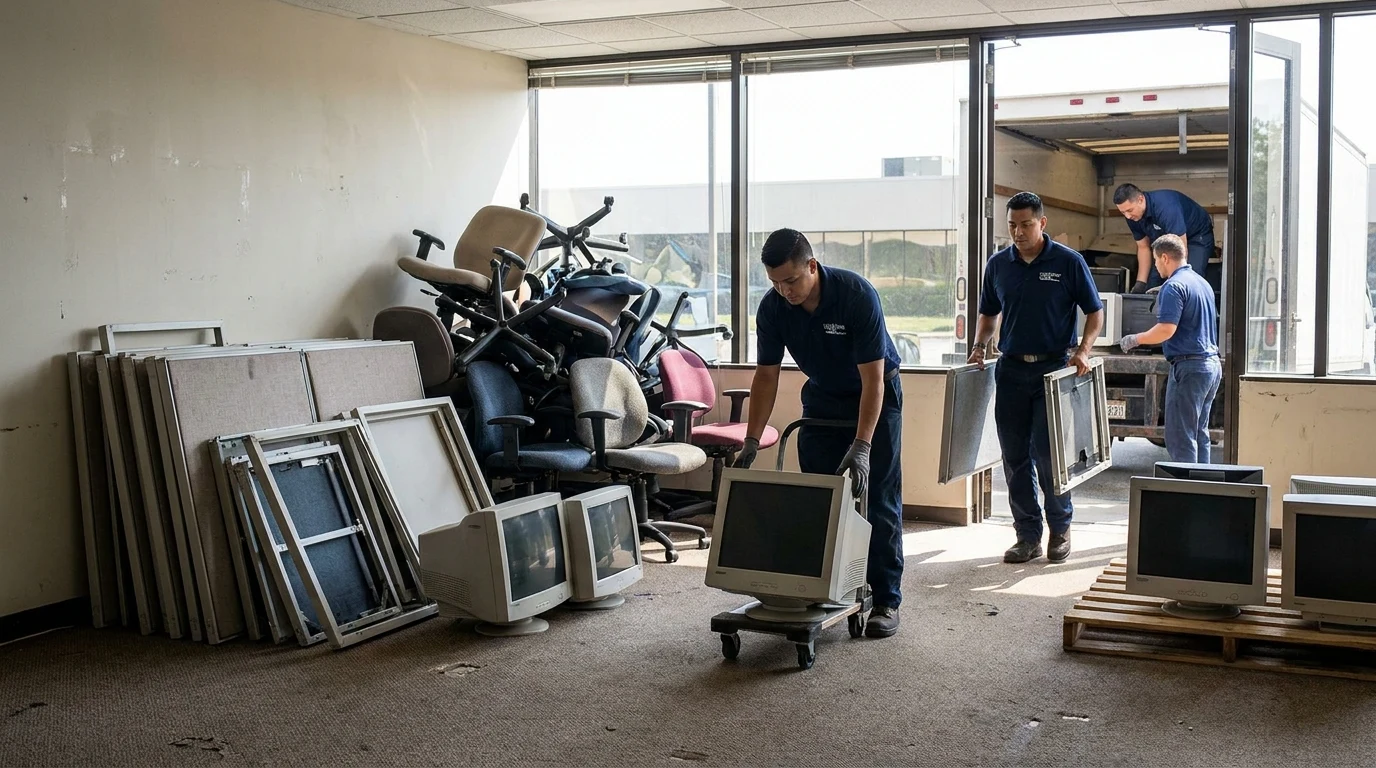
Cubicles are their own category. Most modular systems, like Herman Miller, Steelcase, or older generic knockoffs, don’t come apart quickly. Panels interlock, overhead bins are bolted on, and the fabric-and-frame assemblies are heavier than they look. A full cubicle farm requires disassembly before anything can be moved, which adds time.
Old desks range from light laminate panels that fold apart easily to solid hardwood executive pieces that take two people and a dolly. L-shaped desks are particularly awkward because they don’t fit through standard doorways assembled. A crew with the right equipment disassembles as needed, moves safely, and doesn’t gouge walls in the process.
Electronics deserve careful handling. Monitors, printers, servers, and phone systems can’t go in a standard landfill under California’s e-waste rules. CalRecycle provides guidance on proper e-waste disposal, and we separate electronics at every commercial job for proper recycling. You won’t need to sort ahead of time. Just flag anything that has screens or circuit boards, and we’ll handle the rest.
For appliances, things like breakroom refrigerators and microwaves follow specific disposal paths. Refrigerators contain refrigerant that requires certified recovery under EPA regulations. We coordinate that step for you rather than leaving a fridge in the parking lot and calling it someone else’s problem. Learn more about appliance removal if you have a refrigerator, ice machine, or water cooler on your list.
The practical takeaway: bring a notepad and walk your space before calling us. A quick inventory of electronics, appliances, and any items that need special handling helps us give you an accurate estimate on the first call.
Working around your business hours
Commercial cleanouts almost always have timing constraints that residential jobs don’t. You might need the work done on a Saturday before Monday morning access begins for a new tenant. Or after 6 p.m. so the rest of your team can keep working. Or in phases, floor by floor, over several nights.
We schedule around that. Evening and weekend availability exists for exactly this reason. There’s no surcharge for working outside a standard window when we know about it in advance.
A few things help a scheduled after-hours job run smoothly. Access credentials for parking, elevators, and building entry need to be arranged in advance. If building security requires a vendor list, we get that done before arrival. Freight elevator access matters a lot in multi-story buildings because a crew carrying a file cabinet down a fire stairwell is slow and hard on everyone.
For larger jobs, we sometimes stage work over multiple visits. Day one handles furniture and large items. Day two clears the electronics, small items, and final sweep. This lets you maintain partial operations while the cleanout progresses, which is useful if you’re moving departments in stages rather than all at once.
Same-day hauling is also available for situations where a tenant departure was faster than expected and you need a crew in quickly. We keep capacity for urgent commercial calls throughout the week.
Good communication is what makes a timed commercial cleanout work. We confirm arrival windows, give a realistic load count before we start, and communicate if something changes during the job. No surprises on your end when you’re trying to meet a lease deadline.
Lease turnover and end-of-tenancy cleanouts
Lease turnover is one of the most time-pressured commercial cleanout scenarios there is. Your last day is fixed. The landlord expects a broom-clean space. And whatever the prior tenant left behind is now your problem.
In San Diego’s commercial real estate market, this is common. Buildings in Sorrento Valley, Mission Valley, and Kearny Mesa turn over frequently, and outgoing tenants don’t always take everything with them. Property managers and landlords often call us to clear a space quickly between tenants so it can be shown or re-leased.
For property managers handling multiple buildings, we can work on short notice and accommodate recurring cleanout needs. If you manage a portfolio and need a reliable crew on call, that’s a straightforward arrangement to set up.
Tenants on the outgoing side benefit from documenting the state of the space before and after the cleanout. Photos taken before removal begins, and again after the space is cleared, create a clean record for the security deposit conversation. We don’t manage that documentation for you, but we won’t rush you through the process if you’re doing it yourself.
One item that comes up on commercial leases: tenant improvement buildouts. If the previous occupant installed custom shelving, a reception desk, or built-in cabinetry, those items typically need to be removed as part of lease surrender. That’s construction debris work, and we handle it. Check our construction debris service if your space has built-ins or a small demo component mixed in with the furniture haul.
The cleaner you leave the space, the faster your landlord processes the deposit return and the faster a new tenant can move in. It’s worth scheduling the cleanout with a couple of days to spare rather than the last possible morning.
Pricing for commercial volume
Commercial cleanouts are priced on volume and labor, same as residential work. The difference is that commercial jobs tend to have more predictable volume, which means estimates hold fairly well once we’ve walked the space.
A single executive suite with a few desks and chairs might run a few hundred dollars. A full-floor office with cubicles, breakroom appliances, and electronics will be in the $800-$2,500+ range depending on load count and any specialty items. Multi-floor or large commercial buildings scale from there.
Things that affect the final price: stair or elevator access, whether items need disassembly, electronics or appliance volume, and total truck loads. A quote that doesn’t account for those variables will drift. We give upfront, load-based pricing after the walkthrough so you know what you’re approving before we start.
You don’t pay by the hour with us. You pay for the space your items take in the truck. That model rewards efficiency on our end and gives you a predictable number on yours.
For San Diego businesses running on a budget, it’s worth comparing the real cost of using internal staff to break down and haul furniture against hiring a crew. When you factor in time, potential injury liability, and the fact that most office buildings restrict freight elevator use to approved vendors, a professional crew often costs less than it looks.
When to call us
If you’re clearing a commercial space under a deadline, working around occupied neighboring suites, or dealing with anything heavier or more complex than basic desk chairs, it’s worth calling a crew rather than improvising. Call us at (858) 925-5546 for a same-day estimate.